


Key Takeaway
Salesforce, founded in 1999, revolutionized enterprise software by introducing cloud computing, allowing businesses to manage customer relationships without heavy infrastructure. Co-founders Marc Benioff and his team simplified sales force automation, appealing to both small and large enterprises. The launch of AppExchange in 2004 expanded its offerings, while acquisitions like ExactTarget and Tableau enhanced its capabilities. In 2016, Salesforce introduced Einstein, an AI platform for predictive analytics. The current Customer 360 suite unifies data across departments. Recently, Agentforce 2.0 was launched, utilizing advanced AI to enhance automation and support enterprise teams, addressing resource constraints and improving operational efficiency.
Salesforce, the enterprise software company established in 1999, has transformed from disrupting basic sales management to spearheading the integration of AI in business software.
The company emerged at a time when enterprise software demanded significant infrastructure investments. Large organizations invested millions in complex systems that required dedicated servers, ongoing maintenance, and technical support teams. This created obstacles for smaller companies aiming to manage customer relationships effectively.
Marc Benioff, a former Oracle executive, along with co-founders Parker Harris, Frank Dominguez, and Dave Moellenhoff, recognized an opportunity to deliver software via web browsers. Their initial product allowed businesses to track sales leads and customer interactions without needing to install software locally—a model now referred to as cloud computing.
From sales tracking to complete CRM platform
The company’s early success stemmed from simplifying sales force automation—tools designed to help teams manage leads and customer contacts. This approach resonated with small businesses while also appealing to large enterprises in search of more efficient solutions.
In 2004, Salesforce introduced AppExchange, a marketplace that enabled external developers to create applications integrating with its platform. This expanded the system beyond basic sales tracking, fostering an ecosystem of business software tools.
The company pursued growth through acquisitions, including the purchase of ExactTarget in 2013, which added email marketing capabilities. The acquisition of Demandware in 2016 enhanced its e-commerce functionality, while the Tableau acquisition in 2019 introduced data analytics capabilities.
Einstein brings artificial intelligence capabilities
In 2016, Salesforce launched Einstein, an artificial intelligence platform integrated across its products. This system analyzes customer data to forecast sales outcomes and automate routine tasks.
The platform automatically categorizes support tickets and routes them to the appropriate service agents. For marketing teams, it segments audiences and optimizes advertising campaigns based on historical performance data.
Customer 360 unifies data
Salesforce’s current product suite, branded as Customer 360, consolidates data from sales, marketing, and customer service systems. This enables organizations to track customer interactions across various departments and communication channels.
The company has also developed capabilities for blockchain technology—software that monitors transactions through distributed computer networks. Additionally, it has created systems for Internet of Things (IoT) devices—internet-connected hardware that generates usage data.
Autonomous agents transform automation
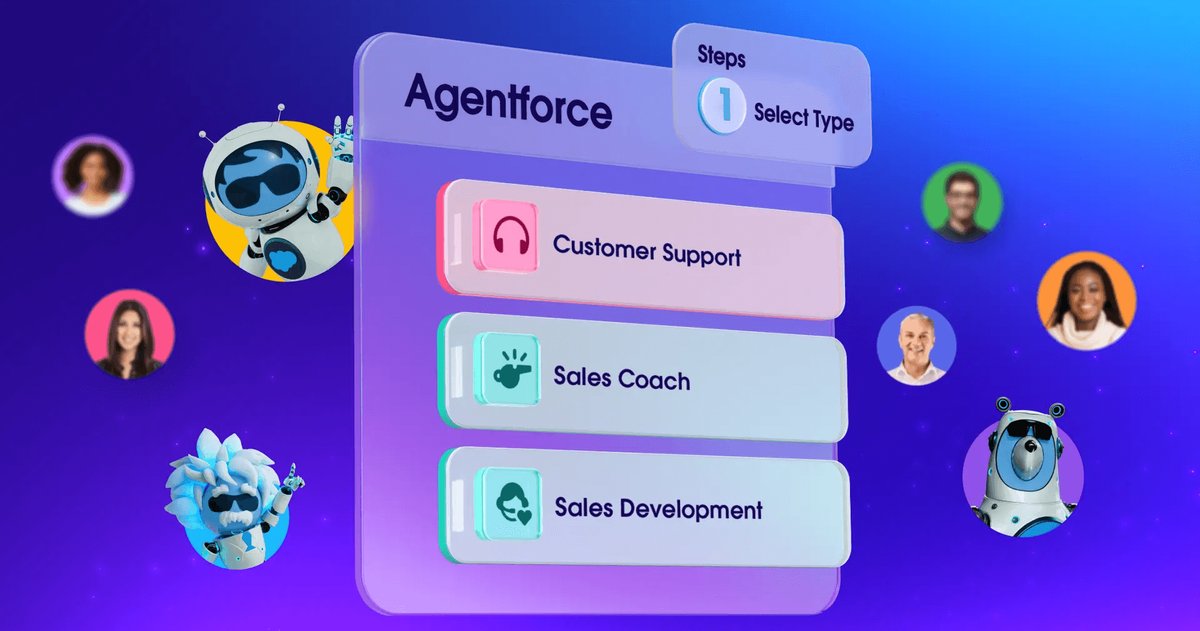
In December 2024, Salesforce launched Agentforce 2.0, allowing organizations to deploy autonomous artificial intelligence systems alongside human workers. The platform utilizes retrieval augmented generation (RAG) technology—software that enables AI systems to access and analyze enterprise data.
“Agentforce 2.0 elevates our revolutionary Salesforce digital labor platform, introducing new reasoning, integration, and customization features that empower autonomous agents with unprecedented levels of intelligence, precision, and accuracy,” says Benioff.
The system addresses the increasing resource constraints faced by enterprise teams. Current solutions, such as copilot systems—AI assistants that enhance human work—often struggle with complex requests or independent actions.
The new platform includes pre-built capabilities for common business tasks and operates through workplace messaging systems. This allows AI agents to manage processes such as personalized job application guidance and product recommendations.
“The demand for Agentforce has been incredible—no other company comes close to offering this comprehensive AI solution for enterprises. We’re seamlessly integrating AI, data, apps, and automation with human efforts to transform how work is accomplished,” says Benioff.
To read the full story in the magazine, click HERE.
Explore the latest edition of Technology Magazine and join the conversation at our global conference series, Tech & AI LIVE.
Discover all our upcoming events and secure your tickets today.
Technology Magazine is a BizClik brand









71 Comments